


A continuous spray bottle keeps misting briefly after you release the trigger. In designs with a liquid buffer, each squeeze pumps liquid into a small chamber. The chamber keeps feeding the nozzle between strokes. Squeeze again before the mist fades and you can keep the spray going.
What Makes the Spray Continue?
When you squeeze the trigger, the pump moves liquid toward the nozzle. In a buffer-based design, some liquid also enters a chamber under pressure. When you release the trigger, that chamber continues to feed the nozzle until the stored pressure falls. The exact mechanism varies by model.
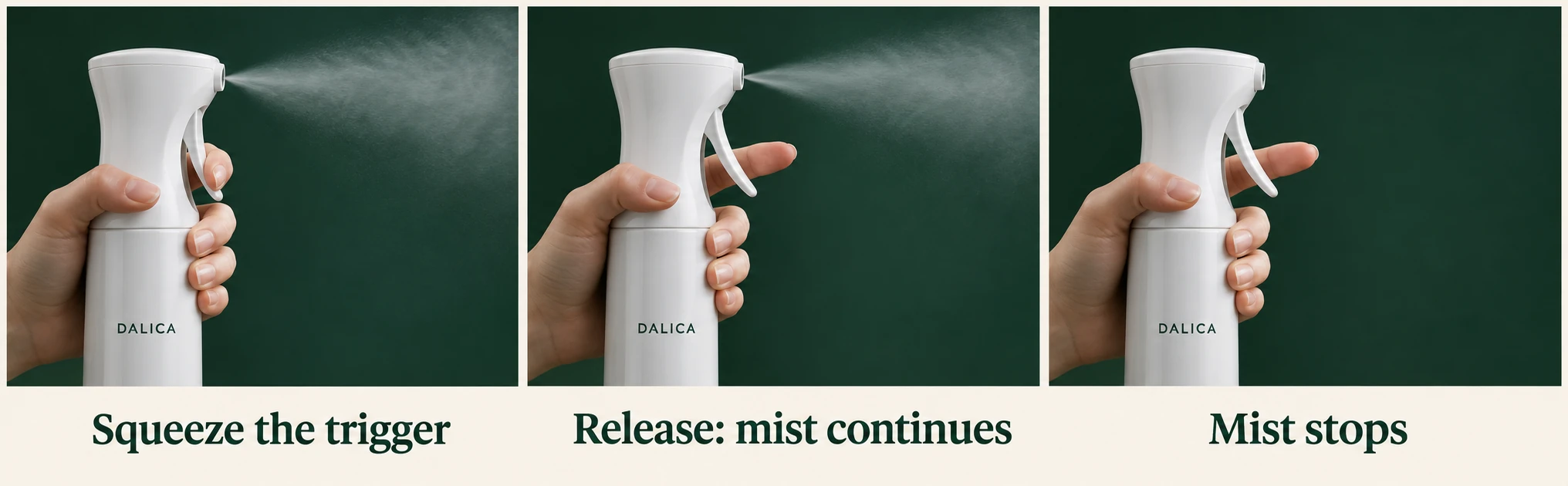
Key Benefits of Continuous Spray Bottles
A sustained mist lets you move the bottle across a section of hair while the spray continues between squeezes. For a leave-in hair mist, this can help spread the formula along a strand without repeatedly wetting the same spot. During sampling, check whether the mist stays even as you sweep the bottle and whether it stops cleanly when you finish.
Continuous Spray vs. Regular Spray Bottles
Watch the nozzle just after you release the trigger. A conventional pump delivers a separate burst with each press. A continuous sprayer can carry the mist into the pause between strokes. “Continuous” describes how long the spray lasts. “Fine mist” describes the droplets.
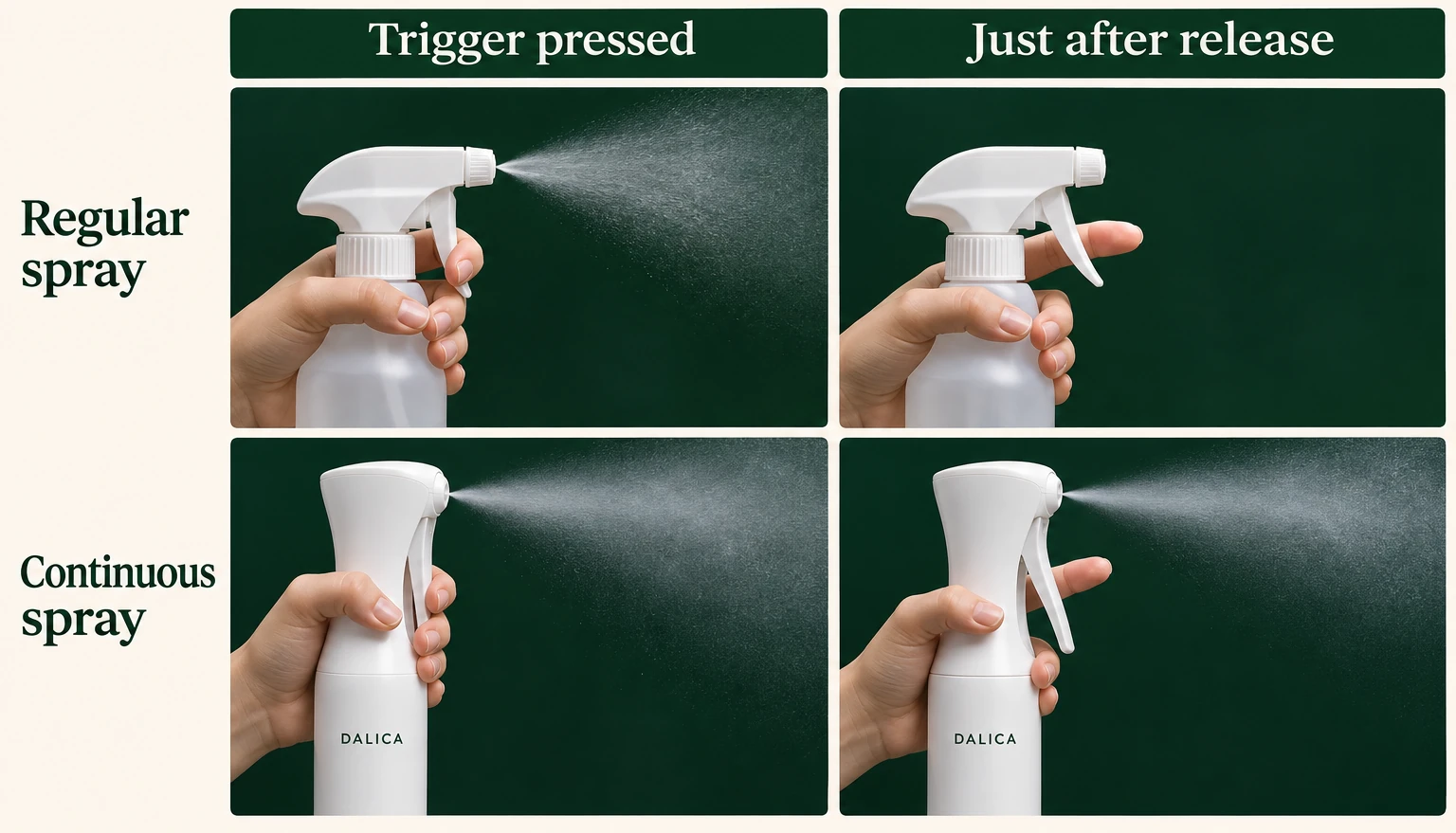
| Feature | Conventional trigger sprayer | Continuous mist sprayer |
|---|---|---|
| Spray delivery | Usually produces a separate burst with each stroke | Can bridge the gap between strokes |
| User experience | Repeated individual sprays | A more sustained application |
| Suitable application | Targeted wetting or general spraying, depending on nozzle | Even mist coverage when the formula and sprayer are matched |
| Selection priority | Output, spray pattern and operating force | Those factors plus sustained-flow behavior |
Neither format is automatically better. A targeted cleaner may need a concentrated spray, while a hair mist may benefit from a wider, gentler application.
Continuous mist systems can also provide propellant-free dispensing. However, that feature alone does not establish the environmental performance of the whole package; material choice, reuse and disposal still matter.
Which Liquids Can You Put in a Continuous Spray Bottle?
Start with the supplier’s approved formulation range. A sprayer that works well with water should not automatically be assumed to work with a finished cosmetic.
For initial selection, pay attention to:
- Viscosity: How easily the liquid flows through the pump and nozzle.
- Surface tension: How the formula behaves as it forms droplets and spreads.
- Particles: Whether suspended ingredients could obstruct small passages.
- Ingredient compatibility: Whether the formula affects seals, valves or other wetted parts.
- Residue: Whether the product dries around the outlet between uses.
A water-based hair mist may be a candidate for evaluation. A thick lotion, particle-containing formula or oil requires a system specifically suitable for that application.
Do not dilute a finished cosmetic simply to make it pass through a sprayer. Select packaging around the approved formula, or involve the formulation team in any proposed change.
How to Evaluate a Continuous Spray Bottle
A sample demonstration is useful, but a purchasing decision needs a repeatable comparison. Use the same formula, fill level, spray distance and actuation pattern when comparing samples.
Check the first use
If the model has a transport lock, release it first. Fully squeeze and release the trigger to prime the pump. Record how many full trigger strokes are needed before the spray becomes consistent. Repeat this on several samples.
The first-use experience matters: a bottle that appears faulty before it primes can generate complaints even if it later performs normally.
Compare the spray pattern
Spray onto a suitable contrasting surface from a fixed distance. Look for an even pattern, concentrated wet spots, large droplets and spitting.
Photographs help document coverage. They do not replace instrument measurements if you need a numerical droplet-size claim.
Measure output consistently
Weigh the filled assembly before and after a defined number of complete strokes.
Divide the weight loss in grams by the number of complete strokes to get g/stroke. If the supplier specifies mL/stroke, divide that result by the measured density of the test liquid in g/mL. Let the mist stop before taking the final weight.
Test after storage
Check performance after the filled package has been stored under the agreed conditions. Compare priming, leakage, spray pattern and trigger operation with the initial results.
Check low-fill performance
Repeat the application test as the bottle approaches empty. Also evaluate any angled-use claim under the conditions the supplier specifies.
A bottle described as a continuous sprayer is not necessarily designed to work upside down.
Why Is My Continuous Spray Bottle Not Misting Properly?
Use the symptom to narrow the investigation before changing components.
| Symptom | Possible areas to check | Practical next step |
|---|---|---|
| No spray on first use | Lock position, priming, assembly and liquid pickup | Follow the model’s setup instructions and complete full strokes |
| Spray stops when tilted | Pickup design and remaining liquid level | Return upright and check the approved operating angles |
| Stream or uneven droplets | Formula suitability or nozzle residue | Compare with an approved reference liquid using a separate sample |
| Performance worsens after storage | Dried residue or material compatibility | Review stored samples and consult the supplier |
| Liquid appears around the neck | Closure fit, seal condition or assembly | Inspect the sealing area separately from the nozzle |
| Trigger does not return normally | Mechanical obstruction or component damage | Stop forcing it and request inspection or replacement |
Follow the supplier’s cleaning instructions. Pushing a pin into a precision nozzle or using an unapproved solvent can damage the part you are trying to clean.
What Should Brands Ask Before Ordering?
A useful sample request should include the formula type, intended application, target fill volume and expected user experience.
Ask the supplier to confirm:
- The formula types the sprayer has been evaluated with.
- The output specification and its measurement conditions.
- The expected spray pattern and operating distance.
- The bottle and closure combination being supplied.
- The permitted operating angles.
- The transport lock or protective closure arrangement.
- The recommended compatibility and leakage checks.
- Whether the package is designed for refilling.
Avoid approving a sprayer solely because the empty bottle looks right or a water sample produces an attractive mist.
Frequently Asked Questions
Does one squeeze produce an unlimited spray?
No. A stroke supplies a limited amount of liquid and energy. Continued spraying requires further actuation.
Can I use it for oil?
Only if the specific sprayer is intended and validated for that oil formulation. A water-misting bottle is not a universal oil sprayer.
Can it be refilled?
Some models are refillable. Confirm the opening method, cleaning instructions and expected reuse conditions for the specific package.
Is the finest mist always the best option?
No. The pattern should suit the product’s intended application. Judge coverage, wetting and controllability together.
Choosing a Sprayer for Your Product
For a 200, 300 or 500 mL hair mist, compare Dalica’s PBS01 continuous spray bottle for hair and PBS02 continuous mist spray bottle. For a smaller pack, consider the 100 mL PBS03.
When requesting samples, share your formula type, target capacity and intended use. Test the complete bottle and sprayer with your finished formula so you can compare coverage, output and how cleanly the mist stops.

 Chat on WhatsApp