

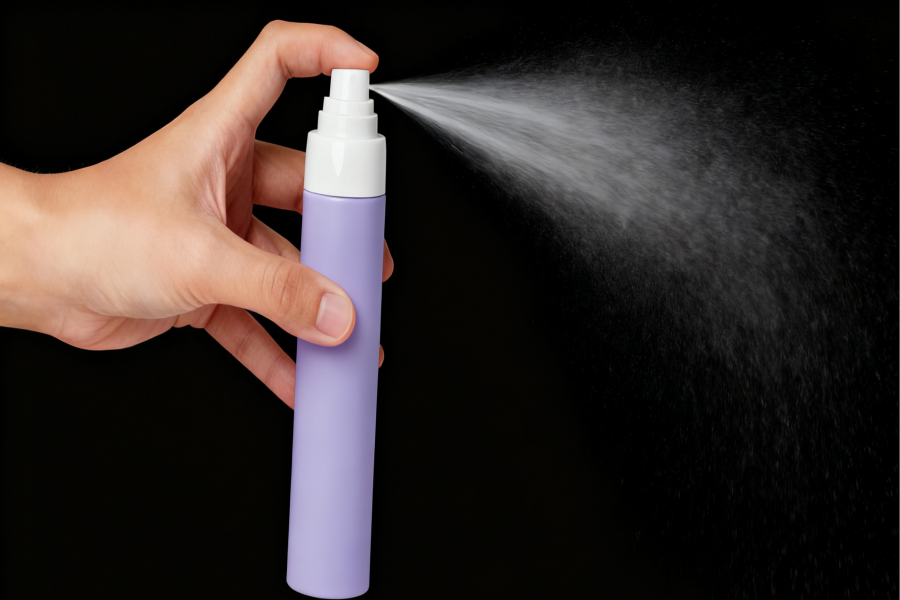
How Do Fine Mist Spray Bottles Work?
Fine mist spray bottles use a mechanical pump and a spray insert to turn a liquid dose into small droplets. Pressing the actuator moves liquid from the bottle through the pump and nozzle; releasing it allows the mechanism to reset for the next stroke. The resulting mist depends on the complete combination of pump, insert, formula, dip tube and bottle.
What Are the Main Parts of Fine Mist Spray Bottles?
A standard fine mist package usually contains the following components:
- Actuator: the part pressed by the user.
- Pump chamber and piston: meter and move the liquid.
- Valves and spring: control flow and return the mechanism.
- Spray insert: helps form the spray pattern and droplets.
- Dip tube: carries liquid from the bottle to the pump.
- Closure and gasket: connect the pump to the bottle and support sealing.
The exact design varies between suppliers and pump models. Not every fine mist sprayer contains identical parts or produces the same output.
How Does a Fine Mist Pump Work?
1. The User Presses the Actuator
The downward stroke moves the piston and reduces the volume of the pump chamber. The inlet path closes as liquid is directed toward the outlet. This creates the flow needed to send the measured dose to the spray insert.
2. The Insert Atomizes the Liquid
Internal passages and the outlet geometry shape the moving liquid before it exits the nozzle. The liquid then breaks into droplets and forms a cone or other defined spray pattern. Insert design, pump pressure and formula properties all affect the result.
3. The Pump Resets
When the actuator is released, the spring returns the piston. The chamber volume increases, the inlet valve opens and liquid is drawn through the dip tube to prepare for the next stroke. Several initial presses may be needed to prime a new package.
What Controls Mist Quality?
| Variable | Possible effect | What to evaluate |
|---|---|---|
| Formula viscosity | Can change atomization and actuation | Spray pattern, droplet feel and recovery |
| Surface tension and ingredients | Can affect breakup, wetting or deposits | Coverage, nozzle condition and consistency |
| Pump output | Changes the amount delivered per stroke | Dose against the intended application |
| Spray insert | Influences pattern, angle and droplet distribution | Coverage at the intended distance |
| Dip tube | Affects liquid pickup and residual product | Length, cut, curvature and final strokes |
| User actuation | Speed and force may change the spray | Performance across representative users |
Viscosity alone does not determine whether a formula will spray well. Alcohol, oils, suspended particles and other ingredients may affect performance or material compatibility. Even pumps marketed for a broad range of viscosities recommend compatibility testing; for example, Aptar’s EuroMist specifications pair different pump versions and inserts with different formula needs.
Fine Mist, Continuous Spray and Airless Are Different
A conventional fine mist pump normally produces one dose during each complete actuation. A continuous spray system can extend delivery beyond a single short pump stroke, depending on its mechanism. Airless packaging describes a dispensing system that typically uses a moving piston, pouch or another arrangement to reduce air entry into the product chamber.
These terms should not be used interchangeably. Confirm the actual mechanism and spray behaviour of the selected model before describing it in product marketing.
How to Test Fine Mist Spray Bottles
- Measure output per stroke across multiple samples and repeated actuations.
- Observe spray angle, coverage, droplet feel and visible large droplets.
- Check priming and re-priming after storage.
- Test for clogging, dribbling and incomplete actuator return.
- Evaluate leakage with the filled package under relevant orientations.
- Check dip-tube pickup and remaining product near the end of use.
- Repeat testing after expected temperature and transport conditions.
Record the formula, fill level, sample size, storage period and acceptance criteria. Terms such as “ultra-fine”, “consistent” or “leak-proof” need a defined test method and result if they are used as measurable performance claims.
How to Select a Fine Mist Spray Bottle
Start with the formula and intended application. Define the desired dose, spray area, application distance, actuation feel and use orientation. Then match the pump’s neck finish to the bottle and confirm the gasket, dip tube and closure system.
Decoration should be approved after the functional package has been selected. Coatings, printing and other finishes must be checked on production-representative bottles, especially near closure and handling areas.
Frequently Asked Questions
Can Fine Mist Spray Bottles Dispense Thick Serums?
Some pump configurations are designed for higher-viscosity products, but suitability depends on the complete formula and required spray. Test the intended pump and insert instead of assuming that every serum can be atomized.
Why Does a Fine Mist Sprayer Dribble?
Possible causes include formula mismatch, incomplete actuation, blockage, loss of prime or a damaged component. Compare filled samples and confirm whether the issue follows the formula, pump or assembly process.
Do Smaller Droplets Improve Formula Absorption?
A fine mist can improve coverage and application feel, but packaging alone does not prove better skin or hair absorption. Such a claim requires evidence for the finished cosmetic product.
Explore Dalica Spray Bottles
Browse Dalica’s spray bottle range, then use the contact page to request samples for formula compatibility and spray-performance testing.

 Chat on WhatsApp